
Calling an album Nothing Lasts Forever usually feels like an open invitation to wallow, but Brock Davis takes the opposite route. Instead of leaning into doom or melodrama, his latest record lands somewhere far more human: reflective, grounded, and quietly reassuring. It’s an album that understands impermanence not as a threat, but as a reason to pay attention. Things change, people change, moments pass and Brock responds by writing songs that linger on what’s worth holding onto right now.
That mindset shows up immediately in the songwriting, which is the clear centerpiece of the record. Across 14 tracks, Nothing Lasts Forever moves comfortably between folk, rock, and country without ever sounding unsure of itself. The arrangements are warm and familiar, but not stale or self-consciously retro. Brock isn’t interested in genre checklists or grit for its own sake; he’s interested in clarity. These songs are built to communicate, not impress, and that confidence gives the album its easy, lived-in feel.
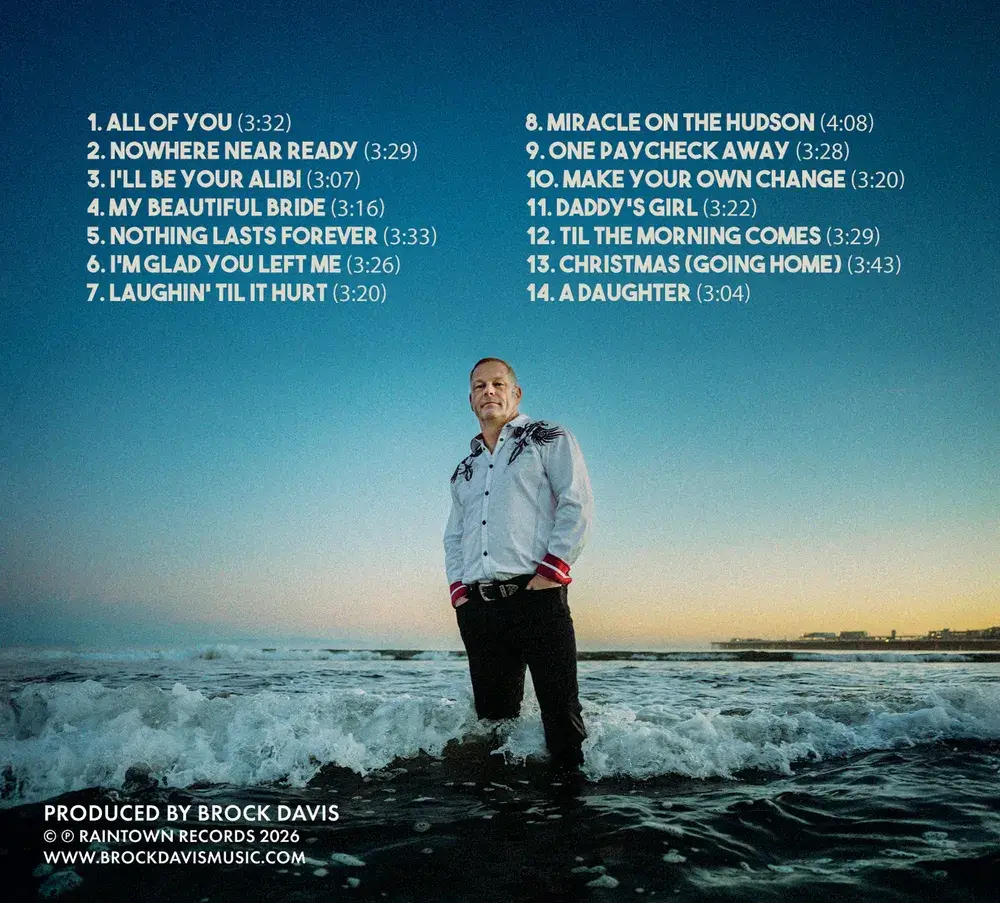
Rather than opening with a mission statement, Brock eases the listener in with “All of You,” a simple country list song about the everyday things he loves about his wife. There’s nothing flashy here; no sweeping declarations or grand metaphors and that’s the point. The song frames love as attention and habit, something chosen daily rather than proclaimed once. It’s disarming in its sincerity and sets the tone for everything that follows.
From there, the album drifts naturally between moods without losing its emotional throughline. “Nowhere Near Ready” stands out as a quiet, unresolved meditation on timing and emotional readiness. Brock resists the urge to explain or justify the situation, letting the discomfort sit where it is. That restraint makes the song hit harder than any dramatic twist would. It understands that not every ending comes with a lesson neatly attached.
Elsewhere, Brock turns up the volume without abandoning nuance. “I’ll Be Your Alibi” brings in a gritty, guitar-forward energy that nods to classic country rock while telling a story about standing up to workplace harassment. What makes the song work isn’t anger, but solidarity. Brock doesn’t frame it as a speech or a slogan; he lets the narrative carry the weight, grounding its message in empathy and resolve.
The album’s thematic center arrives with the title track, “Nothing Lasts Forever,” which embraces impermanence without framing it as defeat. There’s melancholy here, but it’s paired with acceptance and even a kind of optimism. The song suggests that meaning isn’t found despite things ending, but because they do. It’s a subtle emotional pivot point that deepens the rest of the record in retrospect.
That reflective tone carries into tracks like “Laughin’ ’Til It Hurts,” a Mellencamp-style rocker that looks back with affection while acknowledging the cracks in nostalgia. On the other end of the spectrum, “I’m Glad You Left Me” is devastating in its simplicity, dissecting a failed marriage with compassion instead of blame. It’s sad, but also honest in a way that feels oddly freeing.
One of the album’s most ambitious moments comes with “Miracle on The Hudson,” which recounts the emergency landing of US Airways Flight 1549. Rather than turning the story into spectacle, Brock zeroes in on the human choices made when time feels dangerously short. The song is rich with detail but never sensationalized, focusing on love, fear, and resolve in equal measure.
As the record moves forward, Brock widens his lens. “Make Your Own Change” captures the uneasy realization that no one else is coming to fix your life for you, while “One Paycheck Away” offers a compassionate look at economic instability in the U.S., framed through lived experience rather than politics. These songs feel observant rather than prescriptive, continuing the album’s commitment to attention over judgment.
By the time Nothing Lasts Forever wraps up, it’s clear why the album works as well as it does. Brock Davis isn’t writing from despair or nostalgia. Rather, he’s writing from presence. This is an album that finds weight in small moments, meaning in honesty, and comfort in clarity. In a world that moves fast and forgets easily, that kind of focus feels not just refreshing, but genuinely generous.