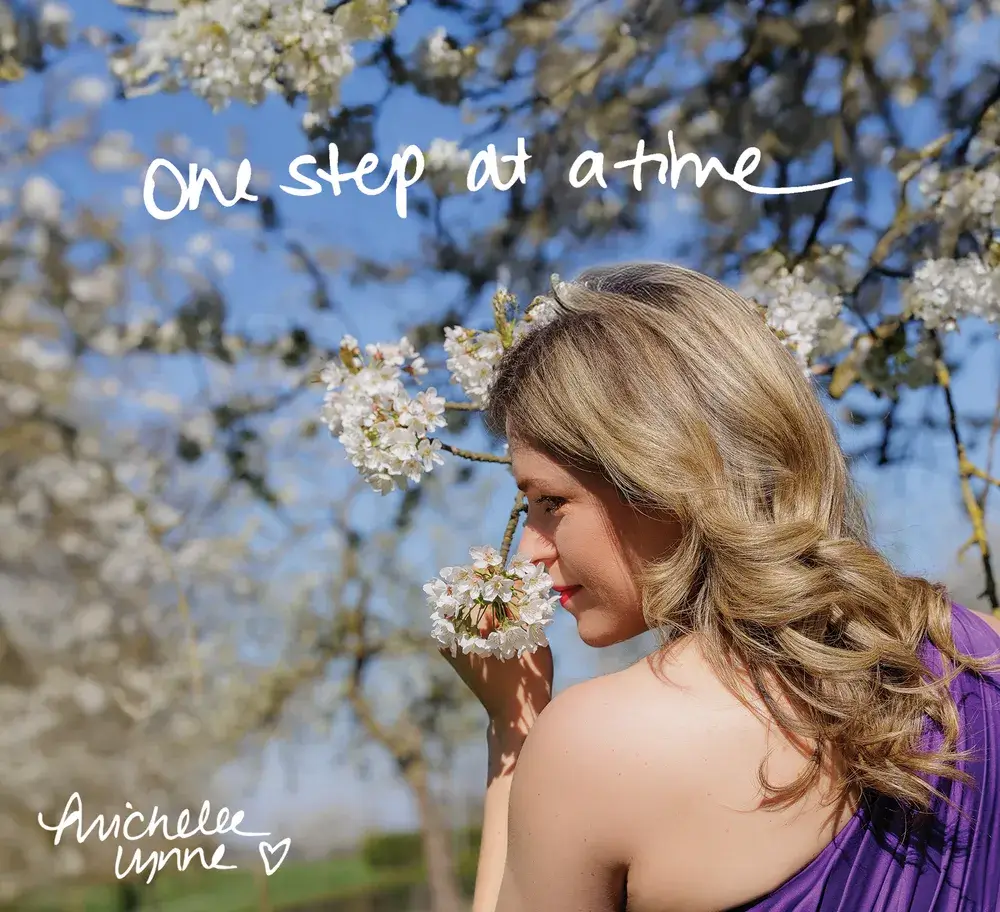
Imagine, for a moment, that you are sitting in a quiet room at 2 a.m., staring at the ceiling, having what I like to call “The Big Emotional Think.” You know the one. The one where you suddenly remember every regret you’ve ever had, every awkward conversation, and every slightly questionable life choice. Now imagine that, instead of doom-scrolling, you put on Michelle Lynne’s debut album One Step at a Time. That is basically the emotional environment this album wants to live in.
One Step at a Time is a record about healing, transformation, and slowly putting yourself back together like an IKEA shelf that came without instructions. And to her credit, Michelle commits to this idea fully. She doesn’t just gesture vaguely at “growth” and “self-care” and then move on. No, she builds an entire emotional ecosystem around it, complete with water imagery, classical piano, soaring vocals, and lyrics that sound like they were written during several very intense journaling sessions.
At its core, One Step at a Time is a crossover album. Which is a polite way of saying: “Yes, I am classically trained, and yes, I also write pop-adjacent singer-songwriter music, and no, I refuse to choose between them.” Michelle blends traditional classical repertoire with her own original songs. And somehow, instead of feeling awkward or mismatched, it mostly works. It’s like watching someone successfully mix formal wear with sneakers and pulling it off.
A big part of why this works is that Michelle is very good at both sides of her musical personality. On the classical end, her piano playing is precise, expressive, and clearly the product of many years of intense practice. On the songwriter side, her voice is clear and earnest, with a tendency toward big emotional choruses and “please listen, I am being vulnerable right now” energy. These two modes don’t fight each other. They collaborate.
The album opens and closes in a way that feels intentional, almost like a narrative arc. We move between instrumental pieces and vocal tracks, between reflection and confession. Songs like “In the In-Between” and “Hold On” act as emotional anchors. They’re about uncertainty, perseverance, and trying not to collapse under the weight of your own expectations. Which, frankly, is extremely relatable content in the year of our Lord 2026.
“Hold On,” in particular, feels like the thesis statement of the album. It’s motivational without being aggressively inspirational. It doesn’t scream “You got this!” at you like a gym poster. It’s more like a friend sitting next to you and quietly saying, “Hey, I know this sucks, but maybe don’t give up yet.” Lines about hidden seeds and slow growth reinforce this idea that healing is boring, gradual, and frustrating and that’s okay.
Then you have tracks like “Empty Promises,” which is basically emotional demolition. This is where Michelle digs into disappointment, broken trust, and the aftermath of relationships that didn’t survive. The lyrics are blunt, repetitive, and intentionally so. “What do I do with all these empty promises?” is not a poetic metaphor. It’s a real question. It’s the kind of question you ask when you’re exhausted and tired of pretending you’re fine.
“Let Me Heal” takes things even further. This song does not do subtlety. It opens with “Carry me on a stretcher / I’m bleeding from within,” which is about as subtle as being hit with a piano. But somehow, it works. The melodrama feels sincere. It’s not trying to be edgy. It’s trying to be honest about pain that feels overwhelming and inescapable.
“In the In-Between,” meanwhile, is the philosophical centerpiece. It’s about liminal spaces: not being where you were, not being where you want to be, and having absolutely no idea what’s next. This is the emotional waiting room of life, and Michelle spends a lot of time there. The song acknowledges uncertainty without turning it into despair, which is harder than it sounds.
“I’m Here” brings in more explicitly spiritual language, focusing on surrender, vulnerability, and being seen. Even if you’re not religious, the emotional logic still lands. It’s about dropping the mask, stopping the performance, and letting yourself exist as a messy, incomplete person. Which, again, extremely relatable.
What makes the album compelling is that it never feels like a branding exercise. It doesn’t sound like “Healing: The Playlist.” Rather, it sounds like someone who actually went through something difficult and decided to process it through music instead of, say, starting a podcast. The fact that this album took several years to write and record shows. It feels lived-in.
There’s also something refreshing about Michelle’s career trajectory. She’s not trying to abandon classical music to become a pop star, nor is she pretending songwriting is just a “side hobby.” She treats both seriously. In doing so, she quietly challenges the idea that musicians have to pick a lane and stay in it forever in an album that is, overall, sincere, cohesive, and emotionally grounded.
This is not an album for blasting at a party. This is an album for walking alone, sitting quietly, journaling, thinking too much, and slowly learning to be okay with where you are. It’s about taking life one small, imperfect step at a time. And honestly? That might be exactly what a lot of people need.
Follow Michelle Lynne
Promoted Content
About the Author

A tenured media critic known working as a ghost writer, freelance critic for publications in the US and former lead writer of Atop The Treehouse. Reviews music, film and TV shows for media aggregators.